Affichage des articles dont le libellé est Africa. Afficher tous les articles

mercredi 24 octobre 2007

a long way gone

Moving...
I will write more on this book when I finish reading. It has just arrived by mail and I cannot take myself from it...


In the meantime you can visit

jeudi 30 août 2007

Dreaming of Africa

A photo from my friend Ibou from Senegal

samedi 14 avril 2007

Anthills of the Savannah

Since nobody recommended me any readings by African authors I found one on my own. And Anthills of the Savannah by Nigerian Chinua Achebe appeared to be one of these books I couldn’t tear myself away from reading until the small hours. The story covers the events which took place in the West African state of Kangan and seems to be a parable on the development in other dictator ruled African states. The novel is “full of a savage irony, set in a country where power has corrupted ideals, terror has silenced all but the bravest, and only fools and flatterers survive” – as it is written on the cover. I couldn’t refrain myself from comparing the plot and the perspective of “Anthills of the Savannah” with a film about Ugandan dictator Idi Amin The last King of Scotland. And I have to say that I liked book much better. One striking contrast between them (and as far I see this distinction is quite relevant in many other cases as well) is a chosen perspective. While in The last King of Scotland the story is mostly seen through the eyes of the European(s), even though the actual main character is Idi Amin, the characters of Anthills of the Savannah are almost without exception African. The perspective affects both interpersonal relations between the characters and their attitudes towards love, death, and not least the country. As things go worse and worse for the characters of the book Kangan still remains their country, not only a place they happen to be for a certain period of time and which in case of danger can be evacuated.
The question of multiple perspectives of the narrative structure is also relevant in the historical research. It has to do with the way in which a particular theme is put into focus, and the kinds of questions which are investigated. So not surprisingly “[t]his has been argued for approaches to African history by Adu Boahen, who proposes that historians should be ‘asking questions and exploring themes of relevance to the African and not the European’…”

mercredi 14 mars 2007

African literature

If you happen to know (or somebody who does) any good African writers who you would like to recommend, I would be grateful for the hints. I have come up with an idea of reading some books written by African authors and need some recommendations. I have already started to search in Wikipedia and just now I am reading “The Interpreters” by Nigerian Wole Soyinka.
Anyway, I was amazed by the biographies of the African writers. So many of them have been either officials or politicians as well. And I am not sure what to think if there are only 13 Ugandan writers in Wikipedia, and among them the contemporary president Yoweri Kaguta Museveni. And it is similar about the other countries as well. I suppose, I would rather read not as much politically engaged literature. But any suggestions are welcome!

vendredi 9 mars 2007

Spaghetti Polonaise

Polish? Well… Country, people… language... Not as well known as English or French of course, neither can it compete with certain other languages which managed to acquire an internationally recognised reputation. But still one cannot deny that it is one of the biggest European languages. This European perspective may however appear to be only a popular misconception… at least when you happen to be out of Europe. But on the other hand… you never know and a sophisticated surprise is welcome. So what may be reactions to a declaration of being Polish, nowhere else but in Africa…

I
In the bus on my way back from the hotel in Casablanca to the airport I was “cross-questioned” by a fellow passenger from one of the Mediterranean countries (he was not from Italy as the title may suggest). The conversation was actually in French which cannot be omitted in order to retell its essence.
-Tu viens de?
-Je suis Polonaise.
-Bolognaise? Alors, tu parles Italienne!
-Je suis Polonaise, pas Bolognaise!

II
Approaching gate at the airport there was another person who asked me the fundamental question where I came from. On my answering I heard this time that a friend of my interlocutor did speak Polish. I took it with a pinch of salt, expecting more another Polonaise-Bolognaise misunderstanding than a Malian speaking Polish in Casablanca. Not strange I was truly taken aback when the woman greeted me by “Jak się masz?” with a perfect Polish accent! Time is changing. And it seems that before 1989 the student exchange at Polish universities was not in as bad condition. At least within the fellow countries, included Mali. It turned out that the Malian lady studied at the academy of sport in Poland during the 1980’s. Even in Gdańsk! Can you imagine!

Frananglais is cool!

After all Frananglais could be next time a remedy to my linguistic confusion in a French-speaking country. It seems to me that I understand it quite well and I would certainly perform much better in Frananglais than in French. I wonder only how the speaking version of Frananglais sounds...

dimanche 25 février 2007

Mali - Part 2

While it is still snowing outside, I continue the Bamako story…

Wedding in Keti

« Le dimanche a Bamako, c’est le jour des mariages… » sing Amadou and Mariam, as far as now my favourite Malian group, which I am listening to quite often here in Oslo. And the words appeared not without meaning since the first Sunday in Bamako my friends and me were invited to a marriage in Keti, not far away from the capital city.

Although we did not see the ceremony itself, we could join the singing party in the village centre. There was a big tent, where all invited women, and we (the only European guests, as it seemed), were sitting, singing or listening to others performance. The men were apparently enjoying the party another place, but I have not got to know where, as I did not ask.
All the best for the young marrieds!


Segou – Festival sur le Niger

The last weekend I went to Segou to join Festival sur le Niger. Although Segou is not a big town, and certainly much smaller than Bamako, the frequency of meeting there a tourist or a resident seemed much higher than in the capital city. All this because of the festival. And since all the hotels were overbooked, the only place left where we could overnight was a terrace of the restaurant Soleil de Minuit. And contrary to my expectations of being eaten alive by the hordes of mosquitoes, since Segou like Bamako is situated on the Niger, I hardly heard one during the night. Segou is simply situated higher than Bamako and mosquitoes are no longer such a plague there.


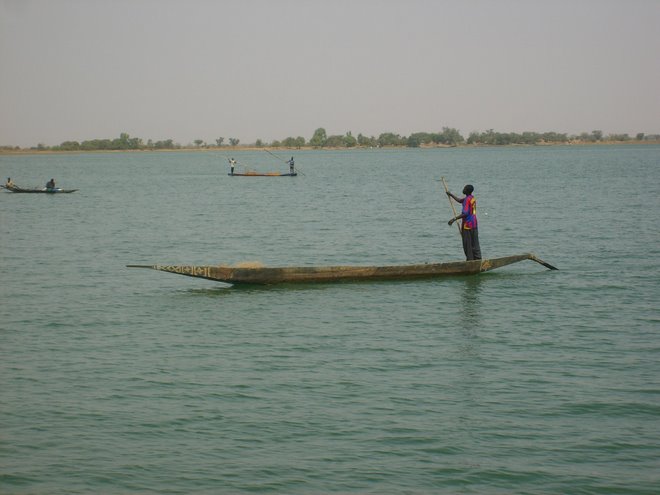
A pirogue trip on the Niger belongs without doubts to the best moments!


The festival scene installed on the river bank attracted many people in the evenings, us among them. The concerts went into the small hours, before we used to return to our terrace lodging. To my great joy Amadou and Mariam was one of the performing groups. I felt really lucky to hear "Beau dimanche" on live.


The last day in Segou was also my last day in Mali...


There are many persons who I did not even mention here, but who made my holidays beautiful! And first of fall who made my holidays possible! Thank you!

samedi 24 février 2007

Mali - Part 1

After a few weeks of digesting my impressions from Mali I feel that it is high time I shared also some other memories than just the linguistic holiday perturbations. I have to refrain myself from describing Mali as a typical African country, since I had never visited any. Neither am I going to give a tourist-friendly description of Bamako or Segou as it can be found in guidebooks. Instead of this I shall recall some of the most enjoyable and exciting moments I have experienced during the fortnight’s holiday in Mali.
Voilà!

Days in Bamako
In the beginning a few words of clarification: I have not been on any safari, and I have seen neither lion, gorilla, giraffe nor hippo, as some had suggested it is a must on a trip to Africa. Firstly, it is not especially usual that wild creatures take a walk in a capital city, I suppose. Secondly, I suspect it was not exactly the best latitude to experience such attractions.

Most of the days I spent getting to know Bamako - Mali’s capital city. Thanks to the kindness of my loyal guide Youssouf, who accompanied me in my daily escapades from Korofina, where I was living, to the different parts of the city centre, I managed to see quite a lot. According to my host I managed to see even more than he had done during three months since he had arrived at Bamako. But it is apparently a question of quality contra quantity, so I cannot completely agree on it.


Le marche des artisians was probably the place in Bamako which I found the most fascinating. Making your way in the crowded streets which form the market’s layout it is possible to buy anything you need. At least almost as possible as it is probable to lose your way. As for my part the unquestioned market hit is a corner with stalls offering equipment for fortune-tellers and other magicians. Fancy a monkey skull or a gazelle tail? Here is the place.


Enjoying the diversity of quite exotic products I followed my wish and bought a fabric for an African dress. With a help of Youssouf and his friend Nana a process of choosing a fabric and later of having it sewn took no more than few days. And still in Bamako I could proudly wear my new dress, which was partly inspired by some traditional local trends.


With regard to Bamako monuments, I think I liked particularly Tour de l’Afrique (left) which overlooks the road to the airport. Maybe it cannot compete with Bank of Africa (right) on being the highest in the city, but it is certainly much more original.


In the need for taking a breath of fresh air after weekdays in Bamako nothing could compare to the tranquil atmosphere of the Tinbuctu restaurant on the other side of the Niger. Invited there by my friend I enjoyed this marvellous place, as well as delicious couscous, with real pleasure. And the peaceful and comfortable Arabic design of Tinbuctu will take a special place in my Bamako memories.


Invitation to Le Centre Culturel Français on the Saturday evening was another pleasant event arranged by my friend. And concert of Malian contemporary most famous singer Salif Keita, which took place there, let me experience and enjoy a top-class of the African music.


T.B.C.

mercredi 14 février 2007

A French point of view

(From Mali - observations on the margin)

A general:
- The French language rules the world
- Even if some people don’t agree with this statement, they have no other choice but to accept it, especially when they happen to visit a French speaking country
- Yes, we do speak also English – sometimes and when we want to – it is you who has to make a try. You don’t understand enough…? What a pity! But we don’t bother.

A particular:
- Poland is not situated in Europe. Ok, it is not Asia, but it is certainly not Europe.
- Polish people are very complicated (= boring) and drink much too much. Every experience has seemed to confirm these assumptions.

The stories about the French not bothering to speak English are well known. But still in France the French cannot develop their national linguistic pride fully. At least some steps to facilitate the international contacts must be taken. Otherwise the European Commission could possibly intervene. But don’t lose hope! There are many places all over the world where the power of the French language can be exercised with a subtle feeling of superiority and where the English appears to be lingua not grata.
The previous French colonies, among them Mali, are without doubt the main area of the French linguistic dominance. Nowhere else is it so natural and easy to claim the priority of the French language. For the obvious reasons Bambara and the other local languages are also tolerated. But having mentioned to a Frenchman (by the way quite neutrally) the fact that the Malian museums lack descriptions in English or having expressed the feeling of being lost in a realm of the French sounds, you risk being blamed for considerably pessimistic attitude on the whole, and in this case in particular.
Therefore when you happen to find yourself in the company of French residents in the previous French colony, you need to take into considerations some circumstances. Letting you sit confused and lost without understanding of the conversation, being held in French of course, should by no means be interpreted as ill-mannered. The French courtesy intends to give you a unique possibility of testing your listening comprehension in French on the spot. Taking it for granted that sooner or later you have to learn French it is indeed a real thoughtfulness.

Uff…
Being an English speaking foreigner in a French speaking country may be tough. And it doesn’t make the situation better if you come from such a vacuum between Europe and Asia, as the area where Poland is situated is said to be for the time being. Just forget about Western and Eastern Europe. Even if such a division does exist, it does not matter, as it is only the western part which actually deserves the name. Accordingly, it is quite unusual to consider Poland as a European country.
After being defined as an out-of-Europe subject I had to face the truth. The Polish lifestyle can be summarized by two standard features: being complicated and drinking too much alcohol. Which of these two is the prior and which the latter or if there is at all any connection between them remains a puzzle, but such are facts. Quite well known facts indeed, not only in France, and the observations have confirmed them too many times.
Not drinking too much, as I never do, I managed at least to fulfil the expectations of being an exceptionally complicated Polish person. Being so complicated I used to consider everything to be too complicated, or much more complicated then it really was. I found it also very complicated to express myself in French and to understand French. But it was me who made it so complicated. If I were not so complicated I would not have found it as much complicated. After all it was not my first contact with the French language, so I should not have found everything so complicated.

P.S. To all my French friends, those from Mali in particular: J’aime beacoup la langue française et un jour je vais parler français et comprendre français bien. Je promis! Vous avez ma parole! Et merci beaucoup pour mon magnifique sejour au Mali!

lundi 12 février 2007

Back from Mali

Hello to everybody! Still under impression of my first meeting with the African continent I put some of the photos on my blog. Of course, there are many photos, so let me just pick up these, I think, which make me strongest remember the African sun even in the snowy Oslo. Bamako, Segou... still on my mind, as if the time has stopped...